
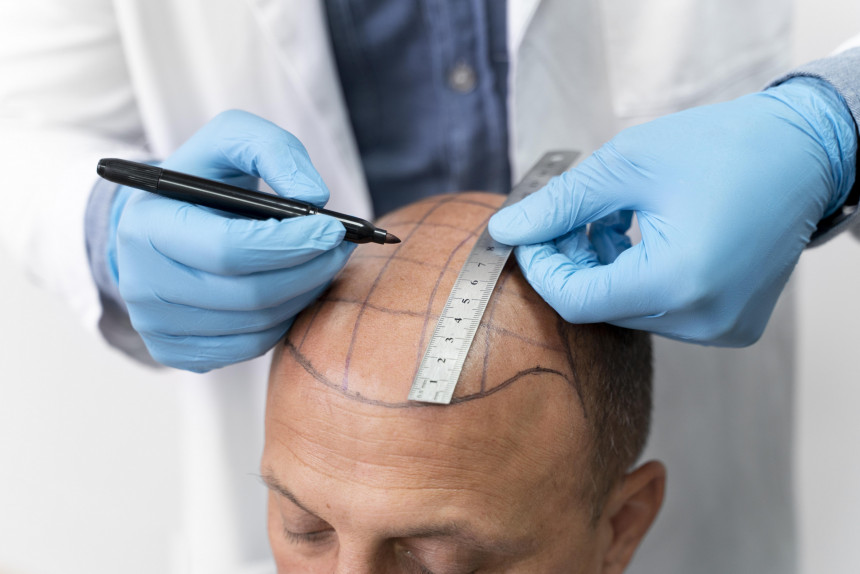
Hair Transplantation
Hair transplantation is a medical and aesthetic surgical procedure aimed at restoring hair growth in areas where hair loss or significant thinning has occurred. It is one of the most advanced fields of modern aesthetic medicine and has become especially popular among both men and women in recent years. The development of the procedure, modern technologies, and precise surgical techniques allow for natural and long-lasting results.
Hair loss can occur for various reasons. The most common cause is genetic, such as androgenetic alopecia, which in men appears as a receding hairline and baldness on the crown area. In women, it more often presents as general thinning of the hair. However, hair loss can also be caused by stress, hormonal changes, thyroid disorders, poor nutrition, vitamin deficiencies, various skin diseases, or medication use. In some cases, hair loss is temporary, while in others it becomes permanent, and in such situations, hair transplantation is considered as a solution.
The basic principle of hair transplantation is the transfer of healthy hair follicles from a donor area to a recipient area. The donor area is usually the back or sides of the scalp, where hair is genetically more resistant to shedding. These hairs are considered “permanent” because they retain their growth characteristics even after being transplanted. The recipient area is the region where hair has been lost or significantly thinned.
Today, the most widely used hair transplantation methods are FUE (Follicular Unit Extraction) and FUT (Follicular Unit Transplantation). The FUE method is the most popular because it is minimally invasive and does not leave large scars. In this method, individual hair follicles are extracted from the donor area and then implanted into the recipient area. The procedure is precise and time-consuming, but it ensures a natural hair growth direction and density.
The FUT method, on the other hand, involves removing a strip of skin from the donor area, from which hair follicles are later extracted. This method can provide a larger number of grafts in a single session, but it may leave a linear scar. Although it is used less frequently today, it is still suitable in some cases.
Before the hair transplantation procedure, a thorough medical examination and consultation are conducted. The doctor evaluates the degree of hair loss, the quality of the donor area, and the patient’s overall health condition. The patient’s goals and expectations are also discussed to ensure a realistic understanding of the results. In some cases, additional tests may be required to determine the cause of hair loss.
During the procedure itself, local anesthesia is usually applied, ensuring a painless process. Depending on the number of grafts to be transplanted, the operation may take several hours. After the procedure, the patient can usually go home the same day, but certain post-operative care instructions must be followed.
The recovery period after hair transplantation is gradual. In the first few days, there may be mild redness, swelling, or sensitivity in both the donor and recipient areas. Within a few weeks, the transplanted hair often falls out, which is a normal process known as “shock loss.” This does not indicate failure, as the hair follicles remain in the skin and new hair begins to grow after a few months.
New hair usually starts to appear within 3 to 4 months after the procedure. Full results are visible after 9 to 12 months. During this time, the hair becomes thicker, stronger, and grows in a natural direction. The result is generally long-lasting because the transplanted follicles retain their genetic characteristics.
The benefits of hair transplantation are numerous. First, it provides a natural appearance because the patient’s own hair is used. Second, the results are permanent, unlike many other hair restoration solutions. Third, the procedure significantly improves self-confidence and psychological well-being, as hair appearance is often closely linked to a person’s self-esteem.
However, like any surgical procedure, hair transplantation also carries certain risks. These may include infection, minor scarring, or uneven hair growth if the procedure is not performed correctly. Therefore, it is very important to choose an experienced specialist and a reliable medical institution.
Today, hair transplantation is considered a safe and effective method for hair restoration. Technological advancements, such as robotic FUE systems and improved implantation techniques, further enhance the precision and naturalness of the results.
Overall, hair transplantation is a long-term solution for individuals suffering from hair loss who wish to regain a fuller hair appearance. It combines medical science with aesthetic artistry, providing patients with not only physical improvement but also emotional and psychological benefits.